The Mechanical Unconscious
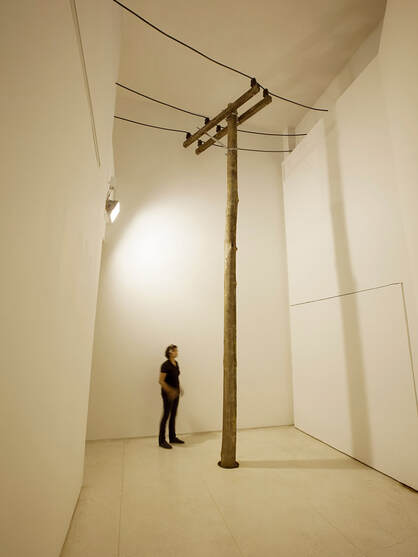
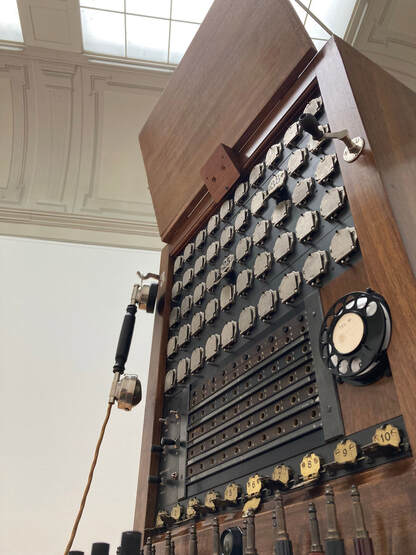
The exhibition space resembles that of an empty and abandoned albeit fully functioning laboratory. The works are mechanisms; at first sight, they are utterly anachronistic. The scene possesses a dreamlike quality. But what type of experiment is there in unceasing execution if the mechanisms appear to have taken on a crazed, disordered life of their own as redress for their utilitarian obsolescence, disobliged from their corresponding function the irrational revenge of the machines? How could we have kept up our relationships to these strange things for so long? This thing that, up until a while ago, had been a telephone what is it now? A curious object, possibly, but no more. In Chaplin's Modern Times, man struggled with enormous mechanical machines. Nowadays he does not even do that. The thing that threatened Charlie has hidden itself. It has vanished from sight to become possibly even more threatening. So this exhibition suggests the drawing of a parabola: the sonorous evocation of mechanical life through contemporary technology. The digital signs, the synthesized voices and the electronic noises that ring incessantly and madly mimic the paraphernalia of sound that surrounds us, like a continuous, insistent and fruitless prayer to the mechanical unconscious. The litany of sounds would awaken those mechanisms, bring them back from their sleep, restore them to existence and remind us of alienation, yet these noises also happen to be the infernal din of that which we call progress, which gives life while simultaneously annihilating it.
text by Paulo Venancio Filho
a transmission of intelligence: blink vox
text by Lilian Zaremba
"...Is it
a fact - or have I dreamt it? - that, by means of
electricity, the world of matter has become a great nerve, vibrating
thousands of miles in a breathless point of time? Rather, the round
globe is a vast head, a brain, instinct with intelligence! Or, shall
we say, it is a thought, nothing but a thought..."
Nathaniel Hawthorne, The House of the Seven Gables
The most radical of all acts of daring transformed night into day with
a simple gesture: turning on the light. From a rather unique idea in
the shadow of the great revolution – one that interfered with natural
time and its biological clock – electricity soon occupied the
epicenter of modern life. In the eighteenth century, scientific
society unleashed a veritably euphoric enthusiasm over electricity
that contaminated philosophers, priests, aristocrats and amateur
adventurers alike, making way for every manner of curious machine –
some of which had no function whatsoever. As the eighteenth century
became the nineteenth, they came to shape the hybrid development of
radio, offered in a complex of techno-scientific models. To accept
this chain as a sequence is to pontificate: in the beginning was the
telegraph.
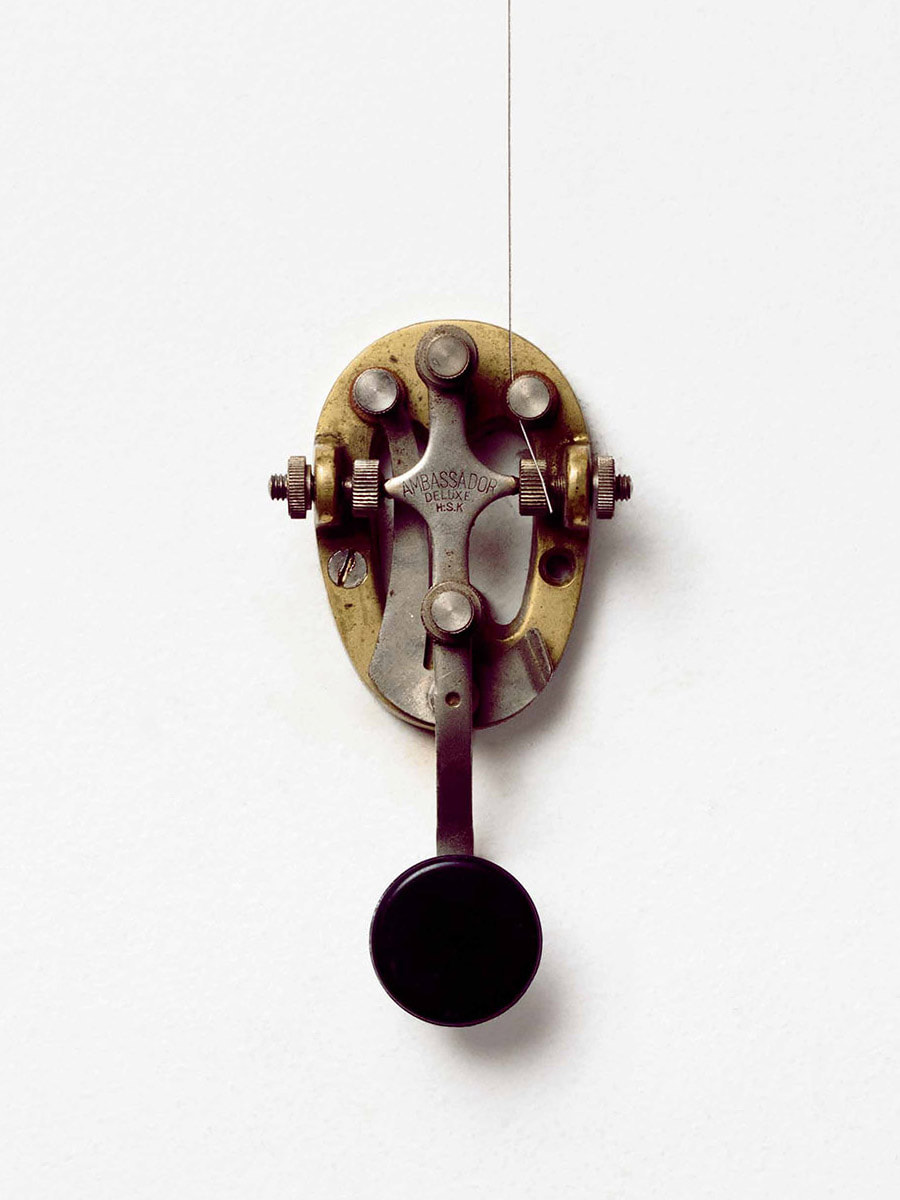
Its invention broke the boundaries of space and time, suggesting to writers such as Hawthorne the end of substance as a signifier of material presence and revealing a wireless form of communication related to thought transference, telepathy, occultism and spiritualist contacts corroborated by prominent scientists in search of a device that would record the human body’s sensations and perceptions as a discourse translatable into mathematical terms. In the genealogy of radio, the principal branch of such experiments emerged with photographer Samuel F.B. Morse’s 1838 plea to United States Congress for funding of his project of “a new and useful machine and system of signs for transmitting intelligence between distant points.”
A partial lack of mastery over his own invention led Morse to describe
the process of transmitting messages as a transmission of
“intelligence”, leaving fuller explanations up to God.
Blink Vox
“...In 1870 a new cable was laid between England and France and Napoleon III used it to send a congratulatory message to Queen Victoria. Hours later a French fisherman hauled the cable up into his boat, identified it as either the tail of a sea monster or a new species of gold-bearing seaweed, and cut off a chunk to take home.”
Neal Stephenson, Mother Earth Mother Board
In the beginning, the “world of the telegraph” was harnessed to transatlantic wires and cables, although Morse himself suggested that such a technical and financial hurdle might be overcome by introducing the idea of wireless communication, making use of water’s electrical conductivity and solar rays. Using a model that might be pleasing to a twenty-first century ecologist, he succeeded in transmitting a message from one bank to another of a Pennsylvania river... Although it didn’t seem to amount to much, the subsequent adventure of radio communication was already there in that early language design and one might well recall Nietzsche: “... The significance of language [for the development of culture] lies in the fact that human beings used it to set up a world of their own beside the other one...”
Hence the sensation of proximity with another world, of observing intelligences, when we are in the presence of this Mechanical Unconscious constructed by Otavio Schipper.
one touch. a current. a system.
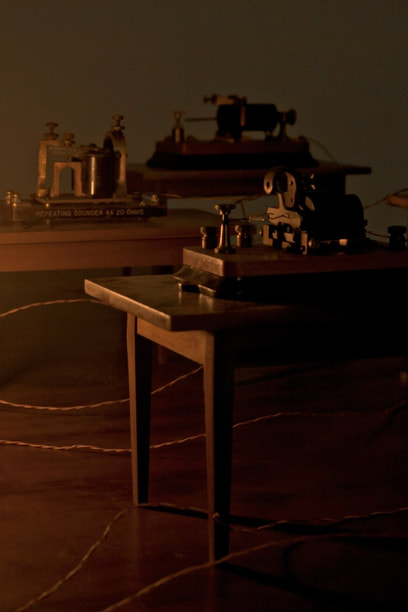
Telegraph machines on tables are interconnected by audio, electrical currents and impulses, equalizing information beat out by tactile, electronic, mechanical, analogical and digital elements. Varying composition signals listening times that are amplified by the length or shortness of the table legs – height as determinant. Our eyes become soundboxes.
a blink. another current. another system.
A visible soundscape, it but echoes the original machinery... Morse’s telegraph needed at least a finger to be activated. There is none here. In this new mechanism proposed by Schipper the telegraph represents that which does not represent; it eludes history to transmit an intelligence of its own, another message articulated in air.
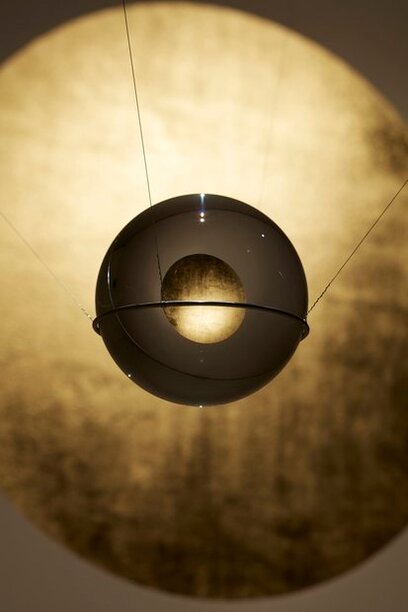
The reflection of a flickering incandescent bulb hovers above the telegraph machines. This suspended light bulb blinks like a voice converting our eyes. It blinks in counterpoint to the beeps that break boundaries in their own way, transforming space into time. But if the voluntary blink of our eyelids occurs at the speed of waves produced over three or four hundred thousandths of a second, what it is that eludes us in this fractioned landscape? What gaze captures the place between one blink and another?
In this installation by Otavio Schipper, art – and the music of Sergio Krakowski – suggest the magical sentence that can elucidate the matter: the unseen is different from the invisible.
It might be a telegraph or a mermaid’s tail... all you need to do is blink.
****
Lilian Zaremba is a visual artist, screen writer and radio producer.
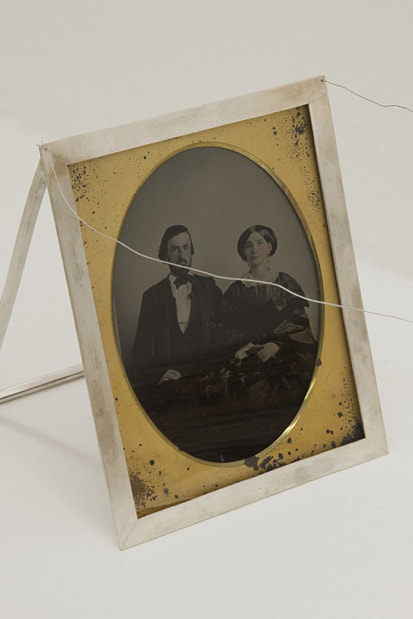
Mechanical Unconscious is an exhibition by visual artist Otavio Schipper and musician Sergio Krakowski. The work consists of a dialogue between old-fashioned telegraph machines, synthetic voices and telephone sounds. The system is entirely controlled by a computer and by various synthetic voices commonly found in digital telephone services. The telegraphs machines are activated by the voice rhythms and dialogue with them in a Morse code of their own, creating an autonomous and dramatic work. These voices were recorded with the assistance of software for the visually impaired. In the exhibition, they read scientific articles, academic theses, codes in abstract languages and long lists of numbers in several languages. Coupled with old telephone audio and answering machine recordings, they create a dense discourse of absurd meaning. The room is lit only by an intermittently flickering incandescent light bulb which glows more or less intensely according to the sound level in the room. Thus, light is also part of this mechanical conversation, and its flickering emits a coded message.
The Mechanical Unconscious proposes an investigation into the nature of language and communication between objects. The dynamic use of sound was executed with rhythmic analysis and synthesis software developed by Sergio Krakowski. Based on these programs and on the choice of captured sound materials, the artists created the first version of the exhibition which remained on exhibition at São Paulo’s Centro Cultural Maria Antônia from June to October 2010, curated by Paulo Venancio Filho. At Anita Schwatrz Galeria, new elements have been introduced to the exhibition in the form of precarious lighting provided by an old incandescent light bulb and the presence of a series of telegraph machines on a wooden platform suspended in the empty space of the gallery.
Otavio Schipper holds a degree in Physics from the Universidade Federal do Rio de Janeiro. He began his visual arts studies with coursework at the Parque Lage and as an assistant to photographer Pedro de Moraes. He did research work on 3D photography with the computer graphics group at the Instituto de Matemática Pura e Aplicada. He participated in the following exhibitions: “Arte Brasileira Hoje” (Museu de Arte Moderna do Rio de Janeiro and Pinacoteca do Estado de São Paulo, 2005), the twelfth edition of the Salão da Bahia (Museu de Arte Moderna da Bahia, 2006), the fifth edition of the Salão Nacional de Artes de Goiás (2006) and Nova Arte Nova (Centro Cultural Banco do Brasil RJ / SP, 2008).
In 2007 he held his first solo exhibition “Borda de Dobras” at the Galeria Millan in São Paulo and, in 2008, the solo exhibition “Fluido Percurso” at Rio de Janeiro’s Paço Imperial. In 2010 he presented the sound installation “Mechanical Unconscious” at the Centro Cultural Maria Antônia in São Paulo.
Sergio Krakowski holds a doctorate in Mathematics from the Instituto de Matemática Pura e Aplicada. He has worked at the Sony/CSL-Paris lab developing a system that uses rhythm as an interface between musicians and computers. This project was presented at the SIGGRAPH ’09 conference in the poster, talk and performance categories. He created the TelecotecnoFunk project for the Biscoito Fino recording label. This was presented in the Humaitá pra Peixe Festival at the Circo Voador and the SESC Noites Cariocas Festival at the Pier Mauá. He paticipated in the Mostra Internacional de Música de Olinda (MIMO) as part of a trio that included Gonzalo Rubalcaba and David Linx, in musician Francis Hime’s show in Montreux and at the Orsara Jazz Festival as part of a trio with Italian jazz guitarist Lucio Ferrara and singer Cristina Renzetti. He has taught percussion workshops in Milan, London, Brighton, and Montpelier.